
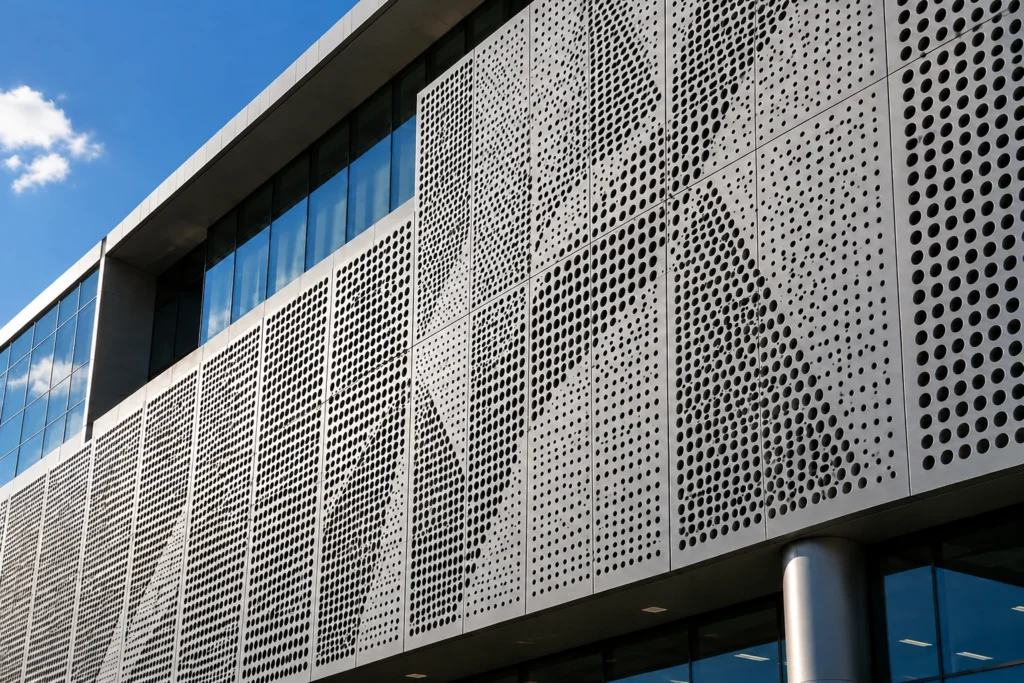
Modern buildings demand more than attractive exteriors. Architects, consultants, contractors, and developers increasingly seek façade solutions that improve energy efficiency, provide natural ventilation, enhance privacy, and comply with modern building standards. Perforated façade systems have become one of the most effective ways to achieve these goals while creating visually distinctive building exteriors.
From commercial towers and shopping malls to airports, car parks, industrial facilities, and mixed-use developments, perforated façade systems combine architectural appeal with practical engineering performance. Their ability to control sunlight, improve airflow, and create unique façade designs makes them a preferred choice across the UAE, the Middle East, and Africa.
What Is a Perforated Façade System?
A perforated façade system is an architectural cladding solution made from metal panels with precisely engineered holes or decorative patterns. These perforations allow controlled airflow and daylight while providing shading, privacy, and a modern architectural appearance.
Perforated façade panels are commonly manufactured using:
- Aluminium
- Stainless Steel
- Galvanized Steel
Advanced manufacturing technologies such as CNC punching, laser cutting, and waterjet cutting allow designers to create simple circular perforations, geometric patterns, custom branding, and decorative architectural designs.
The concept draws inspiration from traditional Mashrabiya screens, which have been used for centuries throughout the Middle East to reduce sunlight, improve ventilation, and provide privacy. Today’s perforated façade systems combine this timeless concept with modern engineering and precision fabrication.
Benefits of Perforated Façade Systems
Solar Shading and Energy Efficiency
One of the primary benefits of perforated façade systems is their ability to reduce solar heat gain.
By filtering direct sunlight before it reaches the building envelope, perforated panels help:
- Lower indoor temperatures
- Reduce cooling energy consumption
- Improve occupant comfort
- Support sustainable building design
This is particularly beneficial in the UAE and GCC region, where cooling accounts for a significant portion of a building’s energy usage.
Natural Ventilation
Unlike solid cladding systems, perforated façade panels allow continuous airflow through the building envelope.
They are ideal for:
- Multi-level car parks
- Plant rooms
- Equipment enclosures
- Utility buildings
- Service areas
Natural ventilation helps improve airflow while supporting passive cooling and smoke extraction where required.
Modern Architectural Design
Perforated façade systems offer almost unlimited design flexibility.
Popular perforation options include:
- Round holes
- Square perforations
- Slotted designs
- Hexagonal patterns
- Decorative geometric layouts
- Custom architectural designs
Architects can customise the hole size, spacing, and open-area percentage to achieve the desired balance between aesthetics, ventilation, daylight, and privacy.
Privacy with Visibility
Perforated panels provide privacy without completely blocking outside views.
They are commonly used for:
- Balconies
- Walkways
- Parking structures
- Commercial buildings
- Residential developments
- Screening applications
This creates comfortable indoor spaces while maintaining visual connection with the surrounding environment.
Durability and Low Maintenance
Manufactured using corrosion-resistant materials and high-quality finishes, perforated façade systems offer long-term durability even in demanding environments.
Available finishes include:
- Powder Coating
- PVDF Coating
- Anodized Finish
These finishes improve resistance against corrosion, UV exposure, moisture, and harsh weather conditions while reducing maintenance costs.
Common Applications
Perforated façade systems are widely used in modern commercial, industrial, and infrastructure projects.
Typical applications include:
- Commercial Buildings
- Office Towers
- Shopping Malls
- Airports
- Metro Stations
- Parking Structures
- Hotels
- Educational Institutions
- Industrial Facilities
- Plant Rooms
- Equipment Enclosures
- Mixed-use Developments
- Decorative Building Screens
- Balcony Privacy Screens
- Architectural Feature Walls
Materials Used
Selecting the appropriate material depends on the project environment, structural requirements, and design objectives.
Aluminium
- Lightweight
- Excellent corrosion resistance
- Easy to fabricate
- Ideal for large façade installations
- Compatible with powder coating and PVDF finishes
Stainless Steel
- Exceptional strength
- Premium architectural appearance
- Excellent corrosion resistance
- Suitable for coastal and high-humidity environments
- Long service life
Galvanized Steel
- Cost-effective
- Good structural strength
- Suitable for many commercial and industrial projects
- Can be powder coated for improved durability
Key Design Considerations
When specifying perforated façade systems, architects and consultants should evaluate the following technical factors.
Open Area Percentage
The percentage of open area directly influences:
- Solar shading
- Airflow
- Privacy
- Daylight penetration
- Building appearance
Selecting the correct open-area percentage is essential for achieving both functional and aesthetic goals.
Panel Thickness
Panel thickness depends on:
- Wind load
- Building height
- Panel dimensions
- Structural support system
Proper engineering ensures long-term performance and safety.
Fabrication Method
Common manufacturing methods include:
- CNC Punching
- Laser Cutting
- Waterjet Cutting
Each method offers different advantages depending on pattern complexity and project requirements.
Installation System
Perforated façade panels may be installed using:
- Concealed fixing systems
- Visible fixing systems
- Cassette systems
- Bracket-mounted structures
The right installation method improves appearance, maintenance, and structural performance.
How to Choose the Right Perforated Façade System
Choosing the right perforated façade system involves more than selecting an attractive pattern.
Important considerations include:
- Building orientation
- Ventilation requirements
- Solar shading performance
- Privacy requirements
- Material selection
- Corrosion resistance
- Structural loading
- Surface finish
- Long-term maintenance
- Overall architectural appearance
Working with an experienced supplier ensures every component is selected to match the project’s technical and architectural requirements.
Why Choose Nextera Insulations?
Nextera Insulations supplies custom-engineered perforated façade systems for commercial, industrial, and infrastructure projects across the Middle East and Africa.
We work closely with architects, façade consultants, contractors, project owners, and developers to deliver façade solutions that combine aesthetics, durability, and engineering performance.
Our capabilities include:
- Custom perforation patterns
- Aluminium, stainless steel, and galvanized steel panels
- CNC punching and precision fabrication
- Powder-coated, anodized, and PVDF finishes
- Technical support from design through installation
- High-quality solutions manufactured to international standards
Whether your project requires decorative architectural screens, ventilation façades, privacy panels, or custom metal cladding, our experienced team can help you select the right solution.
Frequently Asked Questions
What are perforated façade systems used for?
Perforated façade systems are used to provide solar shading, natural ventilation, privacy, and architectural enhancement for commercial, industrial, residential, and public buildings.
Which material is best for perforated façade panels?
Aluminium is the most widely used material because it is lightweight, corrosion-resistant, and easy to fabricate. Stainless steel is preferred where higher strength or enhanced corrosion resistance is required.
Do perforated façade systems improve energy efficiency?
Yes. By reducing direct solar heat gain and improving airflow, perforated façade systems help lower cooling energy consumption and improve overall building efficiency.
Are perforated façade systems suitable for UAE weather?
Yes. Aluminium, stainless steel, and galvanized steel panels with suitable protective finishes perform well in the UAE’s hot, humid, and coastal environments.
Can perforated façade panels be customised?
Absolutely. Hole patterns, perforation sizes, open-area percentages, panel dimensions, colours, and finishes can all be customised to meet project requirements.
Conclusion
Perforated façade systems successfully combine architectural design with engineering performance. They provide effective solar shading, natural ventilation, privacy, durability, and modern aesthetics while supporting energy-efficient building design.
Whether you’re developing a commercial tower, airport, parking structure, industrial facility, or mixed-use project, selecting the right perforated façade system is essential for long-term performance and visual impact.
At Nextera Insulations, we provide custom-engineered perforated façade systems designed to meet your project’s architectural, structural, and performance requirements. From material selection and pattern design to fabrication and installation support, our experienced team delivers reliable façade solutions tailored to every project.
Contact Nextera Insulations
📞 +971 4 263 3071
📧 sales@nexterainsulations.com