
In modern construction and industrial engineering, the selection of insulation materials plays a critical role in determining energy efficiency, fire safety, and long-term operational performance. As infrastructure projects across Middle East and African regions continue to grow in complexity, there is a clear shift toward materials that offer low thermal conductivity, non-combustibility, durability, and environmental safety.
Traditional insulation materials such as fiberglass, polymer-based foams (PUF, EPS, XPS), and mineral wool have been widely used. However, these materials often present limitations in terms of fire performance, moisture resistance, and long-term stability. In contrast, perlite insulation has emerged as a high-performance alternative that meets modern engineering requirements.
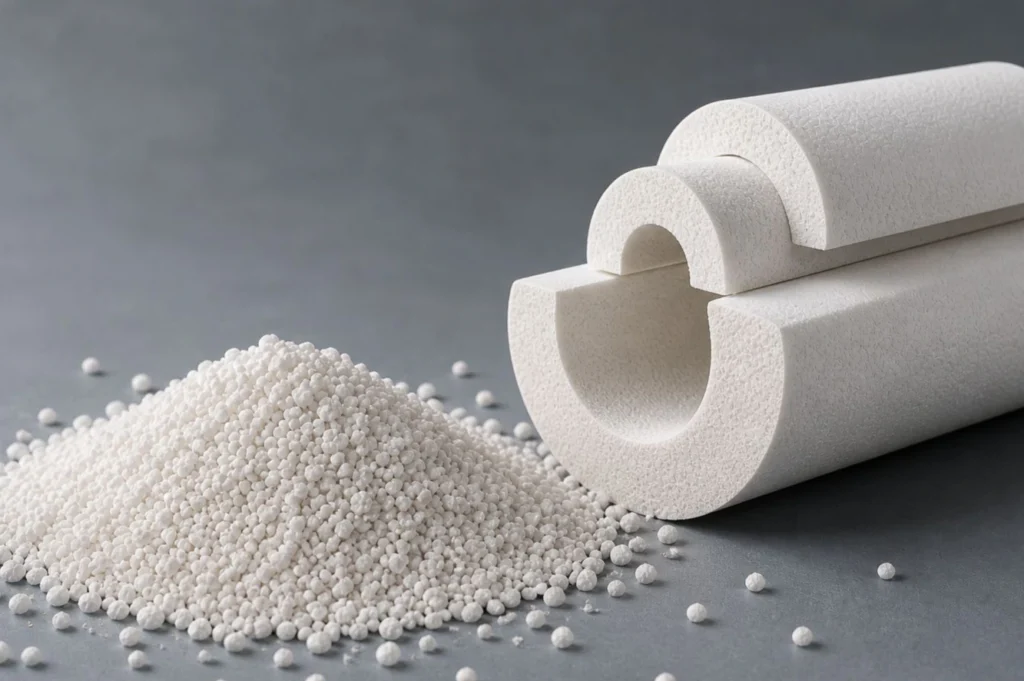
Nextera Insulation manufactures advanced perlite-based insulation products using expanded perlite combined with inorganic binders and reinforcing fibers, resulting in a high-strength, asbestos-free, non-combustible, and moisture-resistant insulation system designed for demanding environments.
What is Perlite Insulation?
Perlite is a naturally occurring amorphous volcanic glass with a high silica content. When heated rapidly to temperatures typically between 850°C and 950°C, the chemically bound water within the perlite vaporizes. This causes the material to expand (exfoliate) to several times its original volume, forming a lightweight, highly porous structure.
This expanded structure contains millions of closed air cells, which significantly reduce heat transfer. As a result, expanded perlite exhibits low thermal conductivity, making it highly effective as a thermal insulation material.
In engineered applications, such as those developed by Nextera Insulation, expanded perlite is processed into boards, blocks, or loose-fill systems using inorganic bonding agents and reinforcing fibers, enhancing its mechanical strength and dimensional stability.
Comparison with Traditional Insulation Materials
1. Thermal Conductivity and Energy Performance
The primary function of insulation is to reduce heat transfer. Expanded perlite achieves this through its low thermal conductivity, typically ranging between 0.040 – 0.060 W/m·K, depending on density and formulation.
- Fiberglass: Moderate thermal performance, but can degrade with moisture
- Foam insulation: Initially low thermal conductivity, but may degrade over time due to aging
- Mineral wool: Stable but less efficient in certain conditions
Perlite provides stable thermal performance over long service periods, making it suitable for both high-temperature and cryogenic applications.
2. Fire Performance and Safety
Perlite is classified as a non-combustible material (Class A fire rating). It does not burn, emit smoke, or release toxic gases when exposed to high temperatures.
- Foam insulation: Combustible unless treated; may emit toxic fumes
- Fiberglass: Non-combustible but binder materials may degrade
- Mineral wool: Good fire resistance but may lose integrity under extreme conditions
Perlite’s inherent fire resistance makes it particularly suitable for:
- Oil & gas facilities
- Petrochemical plants
- High-rise commercial buildings
3. Moisture Resistance and Dimensional Stability
Expanded perlite is inorganic and dimensionally stable, meaning it does not swell, shrink, or degrade significantly when exposed to temperature variations.
While perlite itself is not completely waterproof, engineered perlite insulation systems (such as those from Nextera) are designed to be moisture-resistant, ensuring consistent performance in humid or outdoor environments.
- Fiberglass: Can absorb moisture, reducing effectiveness
- Mineral wool: Susceptible to water retention
- Foam: Resistant to water but may degrade under UV exposure
4. Mechanical Strength and Durability
Nextera’s perlite insulation products are reinforced with inorganic binders and fibers, resulting in:
- High compressive strength
- Structural integrity under load
- Long service life with minimal degradation
Traditional insulation materials may:
- Compress over time
- Lose shape or performance
- Require replacement or maintenance
Perlite insulation provides long-term durability with minimal maintenance requirements, reducing lifecycle costs.
5. Chemical Stability and Environmental Safety
Perlite is chemically inert under most operating conditions, meaning it does not react with common industrial chemicals. It is also:
- Non-toxic
- Asbestos-free
- Free from harmful emissions
In contrast, some synthetic insulation materials may release volatile organic compounds (VOCs) or degrade chemically over time.
Applications of Perlite Insulation
Due to its versatile properties, perlite insulation is used across multiple industries:
Construction and Infrastructure
- Roof insulation systems
- Wall insulation panels
- Lightweight insulating concrete
Oil & Gas and Petrochemical Industry
- Thermal insulation for pipelines
- Fireproof insulation systems
- Equipment and processing units
Cryogenic Insulation
Perlite is widely used as loose-fill insulation in cryogenic storage tanks and annular spaces, where it minimizes heat ingress and maintains extremely low temperatures in:
- LNG storage systems
- Liquid oxygen and nitrogen tanks
Industrial Applications
- High-temperature equipment insulation
- Energy-efficient manufacturing systems
Nextera Insulation: Advanced Perlite Solutions
Nextera Insulation, based in Middle East and African region, specializes in manufacturing high-performance perlite insulation products designed for regional conditions.
Key product characteristics include:
- Low thermal conductivity
- Non-combustible (Class A fire rating)
- Moisture-resistant construction
- High compressive strength
- Long-term dimensional stability
By integrating advanced processing techniques and strict quality control, Nextera ensures consistent product performance across demanding applications.
Why Perlite is a Future-Ready Insulation Material
As global construction standards evolve, there is increasing emphasis on:
- Energy efficiency
- Fire safety compliance
- Sustainable materials
- Long-term performance
Perlite insulation meets all these criteria, making it a preferred choice for modern infrastructure and industrial systems.
Conclusion
When compared to traditional insulation materials such as fiberglass, foam, and mineral wool, perlite insulation offers a superior combination of low thermal conductivity, non-combustibility, durability, and environmental safety.
For projects in the Middle East, and African region—where extreme temperatures and strict safety requirements are common—perlite insulation provides a reliable and high-performance solution.
With Nextera Insulation’s advanced manufacturing capabilities and regional expertise, businesses can implement insulation systems that deliver consistent performance, reduced energy costs, and long-term value.